
← Related research
Why test automation still requires an engineer in the loop
Most test automation stops at "run the script."

The real bottleneck is upstream: someone still decides which sequence to run, watches it for faults, and re-runs it by hand when a build changes. Automation that still needs a person standing next to it is a faster way to wait, not less waiting.
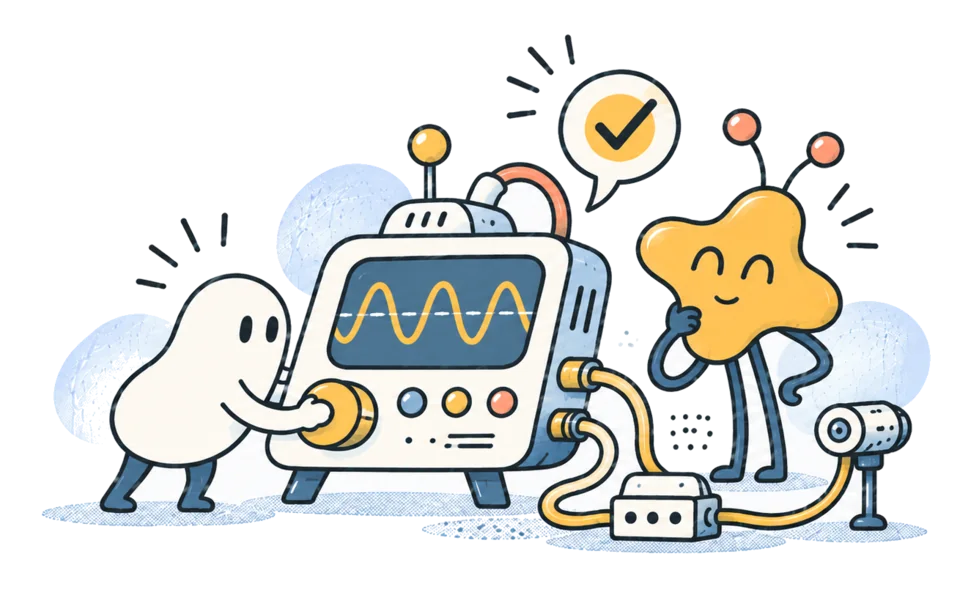
Bounded DDS test sequence
An example run.
Bounded DDS test sequenceExample run
- Steps
- join → record → wait → leave
- scan_min
- 1.748 m
- Rate check
- 6.47 Hz PASS
- Verdict
- pass 1/1
The workflow today
- A person kicks off each test sequence and stays to watch it run
- Faults are triaged live, in the moment, by whoever is on the bench
- Regression checks are re-run by hand against every new build
- Overnight or long-running coverage simply does not happen
With Plotune Nexus
- Orchestrate multi-step sequences across CAN, UART, DBC, XCP, and DDS as one bounded run
- Leave a bounded fault watch running as an async job, so a 2am fault is captured, not missed
- Diff a fresh run against a validated baseline to catch regressions automatically
- Every sequence ends with a packaged, reviewable artifact, not a person's notes
Works with.
Supported integrations for this workflow.

- Test sequences
- Async jobs
- Baseline regression diff
- Multi-protocol orchestration (CAN / UART / XCP / DDS)
More Nexus workflows.

Nexus
CAN / ECU testing
Acquire the interface, send only the approved message, gate on decoded signals and package the run as one reviewable artifact.
See the workflow →
Nexus
ROS 2 / DDS testing
Run unattended hardware tests and judge requirements on live telemetry, without ROS tooling on your side.
See the workflow →
Nexus
AI hardware-in-the-loop
Give AI agents access to real hardware while you keep control of the boundary.
See the workflow →See this mapped to your bench.
Plotune Nexus is one product. This is how it runs against Test Automation & Orchestration.